1
INTRODUCTION
I’
ve built multiple successful tech companies, guided dozens through
vendor nightmares, and saved countless projects from imploding. But
here’s the confession that might surprise you: I’m part of the very industry
I’m about to expose.
I run an IT services company with operations spanning Lahore and Los
Angeles, with experience across the global outsourcing landscape from
Eastern Europe to Latin America, from Vietnam to the Philippines, and
across South Asia. The difference? I’ve built my business as the ethical
alternative while simultaneously exposing the practices I refused to adopt.
This book isn’t written from some moral high ground. It’s written from
the trenches where I’ve fought to operate differently in an industry built
on deception.
Let me be crystal clear about my unique vantage point: I’ve lived this story
from every conceivable angle. I’ve been the desperate CTO watching mil -
lions vanish into offshore blackholes. I’ve been the consultant called at 2
AM when systems collapse and careers hang in the balance. I’ve been the 2
THE OFFSHORE TRAP
service provider competing against firms who sell elaborate fictions wrapped
in enterprise-grade PowerPoints. I’ve sat in rooms where outsourcing exec-
utives openly discuss how to extract maximum payment while delivering
minimum value, all while treating it as standard business strategy.
What I’ve witnessed over twenty years isn’t a collection of isolated incidents
or occasional bad actors. It’s a sophisticated, global system designed with
surgical precision to exploit information gaps, manufacture dependency,
and make accountability virtually impossible.
W elcome to IT outsourcing, a $639 billion global industry built on promises
that rarely match reality. It’s not just big money. It’s economy-warping
money, with tentacles stretching across six continents.
This book is not a “how-to” guide for optimizing your offshore strategy.
It’s not filled with templates for “effective cross-cultural communication”
or tips for “managing remote teams.” Those books already exist, written by
the very people who benefit from keeping you in the dark.
Instead, I’m going to show you what happens behind the curtain of the
greatest ongoing shell game in modern business. Y ou’ll learn why your
“senior developer” is likely a junior with a fabricated résumé. Why your
project timeline mysteriously expands while your budget evaporates. Why
your supposedly “fixed price” contract is anything but fixed. Why your cus-
tom-built system contains shocking security vulnerabilities and backdoors,
some accidental, others deliberately created.
I’ll guide you through the complete lifecycle of outsourcing relationships,
what I call the seduction, the extraction, the captivity, and the reckoning:3
INTRODUCTION
First comes the seduction, where impossible promises, manipulated creden-
tials, and psychological pricing tricks get you in the door. Y ou’ll learn to
recognize the warning signs that what you’re being sold bears no relationship
to what you’ll receive.
Next is the extraction, the systematic draining of your budget through
timesheet fraud, phantom workers, billing for hours never worked, and
deliberate complexity that transforms simple features into “multi-phase
implementation efforts.”
Then comes the captivity, the carefully engineered technical and contractual
prison designed to make escape financially ruinous. Y ou’ll discover how
vendors deliberately create dependency through poor documentation,
proprietary frameworks, and legal structures that make accountability
virtually impossible.
Finally, the reckoning, when the mask slips, the project collapses, and you’re
left with digital garbage that endangers your business, your customers, and
sometimes your career. I’ll show you how to navigate the aftermath and
what options remain when you’ve already been fleeced.
For those who have lived through an outsourcing disaster, these pages will
provide validation that you weren’t crazy. The system really is designed to
exploit you. For those considering outsourcing, consider this your vaccina-
tion against the most common and costly traps. For those working within
this industry who still believe in doing honest work, this might be your
wake-up call that another path is possible.
I’ve changed names and some specific details to protect both victims and
sources, but every story is drawn from real events I’ve personally witnessed,
documented, or had confirmed by multiple industry insiders.4
THE OFFSHORE TRAP
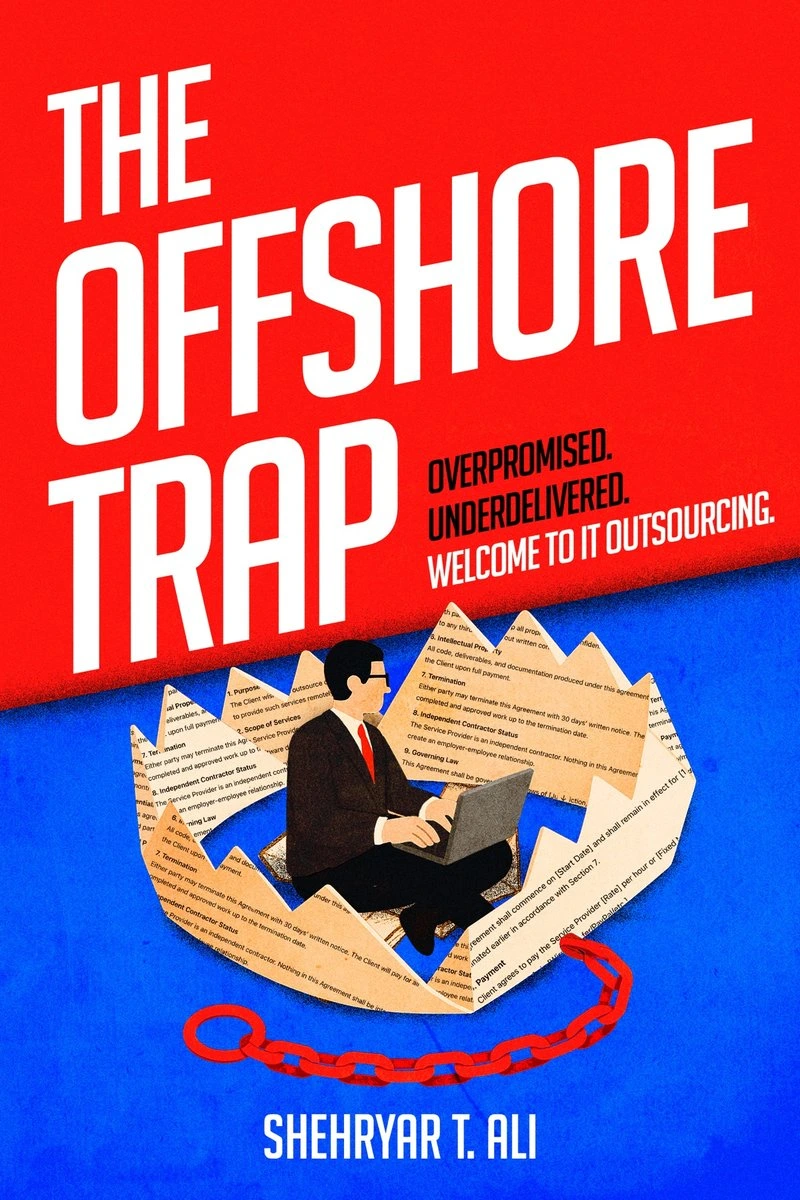
The outsourcing empire has flourished in darkness for decades. Consider
this book the floodlight that exposes not just what the industry does, but
precisely how it does it, and how the game is about to change forever.
So buckle up. W e’re about to pull back the curtain on the $639 billion IT
outsourcing empire, where the most valuable product isn’t software or
systems, but the sophisticated illusion of value itself.7
CHAPTER 1
THE OUTSOURCING EMPIRE
I
t was 2 AM when the CEO’s call jolted me awake. “Everything’s gone,”
she whispered, voice cracking with panic. “The entire platform is down.
W e’re losing $10,000 an hour. Users are flooding social media with com-
plaints. And our vendor’s team? They’ve vanished.”
This wasn’t my first middle-of-the-night disaster call. Not even close.
Thirty minutes later, I walked into their downtown office, stepping into what
looked like a war zone. The executive team had been there for 36 straight
hours, wild-eyed, running on nothing but adrenaline and fear. Empty coffee
cups and takeout containers littered the conference room table. The CTO
hadn’t slept in days, his normally crisp appearance now a rumpled mess as
he stared blankly at dashboards showing a flatlined e-commerce platform.8
THE OFFSHORE TRAP
“W e trusted them completely,” he said, not even looking up as I entered.
“Paid them $1.3 million for a ‘world-class, enterprise-grade platform.’ Now
look at us.”
Their vendor, one of India’s most prestigious IT services firms, with gleam-
ing offices in Bangalore and slick salespeople in New Y ork, had built their
entire e-commerce infrastructure on technical quicksand. The system had
collapsed precisely when they needed it most: during their biggest seasonal
promotion, with transaction volume at its peak.
The “dedicated senior team” that had impressed them during sales pitches
was nowhere to be found. The promised “24/7 emergency support” was
responding with canned messages about “investigating the underlying issue”
while the company bled money by the minute.
What I uncovered over the next 72 hours was what I always find: an archi-
tectural house of cards that was never designed to handle real-world load.
Security so fundamentally compromised it would make first-year computer
science students cringe. Documentation that was either nonexistent or
deliberately obscured. And the code itself, thousands upon thousands of
lines, copied wholesale from open-source libraries and stitched together by
developers who clearly didn’t understand what they were implementing.
The senior architects who’d dazzled executives during the sales cycle had
never written a single line of code for the project. The “rigorous quality
assurance process” mentioned in every status report had never actually been
performed. The “dedicated team of senior engineers” they’d been introduced
to over Zoom existed only as names on an organization chart, while the actual
work was done by a rotating cast of junior developers making $8-10/hour.9
THE OUTSOURCING EMPIRE
I’ll never forget the moment when I showed the CEO the evidence. W e were
alone in her office, looking at the repository logs that proved beyond doubt
that the “20-person team” they’d been paying for was actually 3-5 inexperi-
enced developers, none of whom matched the résumés they’d been shown.
“How is this even legal?” she asked, her voice barely audible.
It’s a question I’ve heard hundreds of times. And the answer is both simple
and infuriating: this elaborate con persists because the entire system is built
on information asymmetry, geographic barriers, and jurisdictional firewalls
specifically designed to make accountability impossible.
The Trillion-Dollar Shell Game
I’ve spent over two decades in this industry, becoming the consultant com-
panies call when outsourced projects implode, when the glossy promises
evaporate, when the systems collapse, when millions have been spent with
nothing functional to show for it. I’ve sifted through the wreckage of more
failed projects than I can count, and the patterns aren’t just similar; they’re
identical.
The case that changed everything for me happened back in 2015. A U.S.-
based hospital network had spent $2.7 million on a patient management
system from one of the “Big Four” Pakistani IT firms. After 18 months of
development, what they got was a catastrophe, a system so fundamentally
broken that it had to be shut down hours after launch when it began ran -
domly mixing up patient medication records.
As I dug through the technical disaster, what I found wasn’t just incompe-
tence. It was systemic fraud. The vendor had sold them a “custom solution 10
THE OFFSHORE TRAP
built specifically for your unique healthcare requirements.” What they
delivered was a barely modified version of a generic system they’d built for an
entirely different industry, with healthcare features bolted on by developers
who had no medical domain knowledge whatsoever.
The documentation claimed extensive HIPAA compliance testing. None
had been performed. The security audit reports in the project repository
were completely fabricated, literally copied from another project with only
the client name changed. The “senior healthcare IT architect” who had
impressed executives during sales calls had logged a total of six hours on the
project, all during the initial kickoff phase.
When I presented my findings to the hospital board, the room fell com -
pletely silent. Then the CFO spoke: “So you’re telling me we paid nearly
three million dollars for a system that was never going to work? That they
knew would not work?”
That’s exactly what had happened. And I’ve seen the same scenario play out
countless times since, across every industry, company size, and geographic
region. This isn’t occasional bad behavior by a few unethical players. It’s the
standard operating procedure for a global industry that’s perfected the art
of promising one thing while delivering another.
These systemic failures aren’t limited to my personal experiences. The Hertz
lawsuit against Accenture made headlines when they sued after paying more
than $32 million for a website redevelopment that failed spectacularly. The
suit alleged Accenture didn’t even create a responsive design that worked
across devices in 2019! That’s like hiring a professional chef who forgets to
turn on the oven. When a global corporation with sophisticated procure -
ment processes and deep pockets gets taken for a ride this egregious, imagine
what happens to organizations with fewer resources and less leverage.11
THE OUTSOURCING EMPIRE
What makes this machine so effective is how it systematically exploits infor-
mation gaps. Most clients can’t effectively evaluate what they’re buying.
They can’t distinguish between genuine technical complexity and manufac-
tured obfuscation. They have no way to verify that the impressive “senior
architects” they meet during sales pitches will ever touch their project. And
by the time they discover the truth, they’ve invested so much that starting
over seems impossible.
The sales pitch has evolved brilliantly over time. Fifteen years ago, it was
nakedly about cost: “Our developers are 70% cheaper!” Now that same
pitch comes wrapped in consultant-speak: “strategic partnership,” “digital
transformation enablement,” “global talent access strategy.” Same cheap
labor, fancier wrapping paper.
And governments don’t just allow this system, they actively subsidize it.
India’s SEZ (Special Economic Zone) tax breaks. The Philippines’ PEZA
incentives. Poland’s technology investment credits. These countries aren’t
accidentally becoming outsourcing hubs. They’re funding an industry
that promises their citizens a path to the middle class, even if that means
systematically misleading W estern clients about capability and quality.
I’ve witnessed this firsthand in government meetings where officials explicitly
discuss how to position their country’s “cost advantage” to attract foreign
clients, while showing zero concern about whether those clients receive the
value they’re paying for.
COVID was the outsourcing industry’s golden opportunity. When remote
work became normalized overnight, the geographic barriers that had pre -
viously given clients pause suddenly vanished. If your developer can work
from home in Denver, why not Delhi? The floodgates opened, and the
industry expanded into markets that had previously been resistant.12
THE OFFSHORE TRAP
This isn’t just a con operating at global scale. It’s one moving billions of dol-
lars through a system that consistently promises one thing while delivering
another, all while making accountability virtually impossible.
Different Accents, Same Scam
Each geography has perfected its own unique marketing wrapper while
delivering the identical dysfunctional model.
Latin America has mastered the “we’re practically in your office” narrative.
Their sales pitch oozes with promises of time zone alignment, cultural
compatibility, and “true Agile collaboration.” Firms in the Dominican
Republic, Mexico, and Colombia will spend hours explaining how their
9-to-5 overlaps perfectly with yours, as if sharing working hours somehow
prevents their developers from copying open-source code and billing you
for “custom development.” That status call might be more convenient, but
you’re still getting the same empty progress reports, just without having to
wake up at 6 AM.
Eastern Europe sells the “superior engineering mind” fairy tale. From
Ukraine to Romania to Poland, they’ve built their pitch around the
mythology of the elite Eastern Bloc engineer with a master’s in computer
science and mathematical thinking supposedly light-years beyond their
Asian counterparts. Their sales decks showcase gleaming tech universities
and Olympic programming medalists. What they don’t show is how those
credentials are just as fabricated, those architectures just as flawed, and those
estimates just as manipulated as anywhere else on the planet.
South and Southeast Asia continue betting on the cost narrative but with
a sophisticated twist. The pitch from India, the Philippines, Pakistan, and 13
THE OUTSOURCING EMPIRE
Vietnam now acknowledges the quality concerns upfront: “Y es, there are
bad offshore vendors, but we’re different, we’ve solved those problems AND
we’re still 70% cheaper!” It’s a masterful psychological play: by acknowledg-
ing the stereotype, they position themselves as the exception. The code is
still garbage, the architects still disappear after signing, and the project still
fails, but they’ve inoculated themselves against the most obvious objections.
The newest player in this regional masquerade? Africa. From Egypt to Kenya
to Nigeria, the emerging pitch combines “untapped talent” with “final
cost frontier” messaging. They’re selling the romance of helping develop
emerging economies while simultaneously exploiting them for margins that
would make even the most hardened Indian outsourcing executive blush.
Don’t be fooled by the geographic window dressing. Whether it’s delivered
with a Latin accent, Eastern European directness, Asian deference, or
African enthusiasm, it’s the same broken model, same empty promises, and
same inevitable disappointment. The outsourcing scam doesn’t improve
with a change in longitude and latitude.
The Human Cost
Beyond the wasted billions and failed technology lies the human wreckage
this industry leaves behind. I’ve witnessed careers and companies destroyed
when outsourcing goes catastrophically wrong.
Three months after we finally stabilized that e-commerce platform I men -
tioned earlier, the CEO who had called me at 2 AM was asked to resign.
Despite the fact that the vendor’s fraud was extensively documented, the
board needed a scapegoat for the missed revenue targets and the millions in 14
THE OFFSHORE TRAP
emergency remediation costs. She became the face of a failure she had tried
desperately to prevent.
I’ll never forget the look on her face when she called to tell me. I’ve seen that
same expression hundreds of times since, the shocked realization that they’re
being held accountable for someone else’s deception. If you’re reading this
and getting that uneasy feeling that your outsourcing relationship might
not be what it seems, pay attention. That instinct might save your company,
and your career.
The casualties aren’t just on the client side. The human machinery that
makes this industry possible suffers in ways most clients never see.
Those gleaming “innovation centers” you see in vendor marketing materials?
I’ve been behind the scenes. Many are Potemkin villages that exist only
for client visits. I knew of one in Hyderabad that was fully staffed with
busy-looking “senior developers” whenever clients toured the facility. In
reality, it was a showcase filled with employees pulled from other projects
or even hired temporarily just for the visit.
The actual work happens in very different conditions. I’ve seen what the
“offshore delivery model” really looks like on the ground: overnight shifts
in crowded rooms, developers sleeping under desks during crunch periods,
two or three people sharing a single workstation across different shifts. I’ve
known developers who were forced to work 80-hour weeks while being
paid for 40, threatened with termination if they didn’t “voluntarily” work
weekends to meet impossible deadlines their managers had promised clients.
That $100/hour “senior developer” rate you’re paying translates to maybe
$10/hour for the person actually writing your code, after every layer of 15
THE OUTSOURCING EMPIRE
management extracts their cut. The client believes they’re paying for exper-
tise. The developer believes they’re being exploited. Both are correct.
Even when everyone has good intentions, the fundamental cultural gaps
often doom projects from the start. W estern clients expect direct com -
munication about problems. Many offshore teams come from cultures
where saying “no” or admitting difficulties to a superior or client is deeply
uncomfortable.
A project manager from a major outsourcing firm once confided in me:
“The client asks if we can deliver by Friday. My team knows it’s impossible.
But they say ‘yes, sir’ because saying no feels disrespectful. I say ‘yes, sir’ to
the client because all my developers said yes. The client hears yes. Nobody
believes it, but nobody can say it.”
This communication gap isn’t just frustrating. It’s financially catastrophic.
Problems that could be fixed with a one-day delay if identified immediately
turn into two-week disasters when they’re hidden until the last possi -
ble moment.
The outsourcing industry isn’t just a business model. It’s a human meat
grinder that chews up careers, companies, and dreams on both sides of the
equation. The real cost isn’t measured in dollars wasted but in companies
that never reach their potential, products that never help their users, and
careers permanently derailed by forces most participants don’t fully under-
stand until it’s too late.
I’m writing this book because I’m tired of watching good people get
destroyed by a system designed to extract maximum profit while delivering
minimum value. I’m tired of picking through the wreckage of failed projects 16
THE OFFSHORE TRAP
that should have succeeded. I’m tired of seeing the same patterns repeat while
everyone pretends they’re isolated incidents rather than systematic failures.
By the time we brought that e-commerce platform back online after four
days of emergency work, we’d barely saved the company. They lost millions
in revenue, market share they’ll never recover, and the trust of their custom-
ers. The CEO lost her job. The CTO will probably be next.
As I was leaving, she pulled me aside. “Why doesn’t anyone talk about
how fundamentally broken this industry is?” she asked. “Why didn’t any -
one warn us?”
That’s exactly why I’m writing this. Consider yourself warned.